
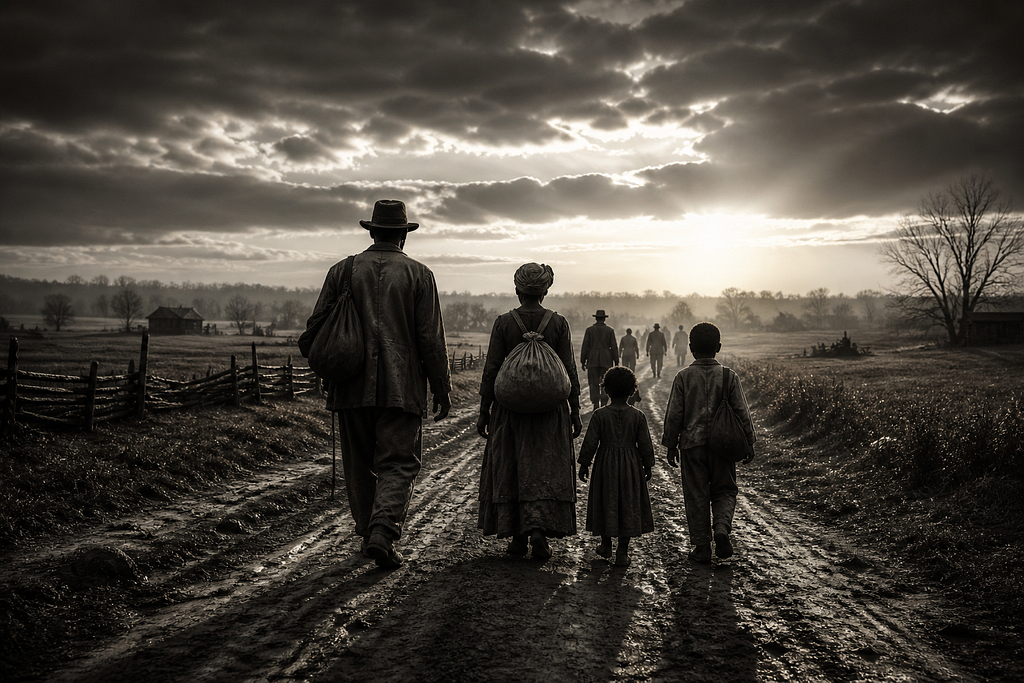
Freedom Was Given. Stability Was Not
There is a difference between being free and being secure, and history has a way of softening that distinction just enough for people to feel comfortable with the version they have been given.
We have been taught to view the end of slavery as a finish line, a moment where everything shifted and a new reality began, as if the transition from bondage to freedom created an immediate pathway to stability. But history does not move that cleanly, and when you take the time to examine what actually followed, it becomes clear that freedom was granted without any real consideration for what it would take to sustain it.
Newly freed Black families were not stepping into opportunity. They were stepping into uncertainty at a scale that is difficult to fully comprehend. There was no coordinated system in place to provide food, shelter, or medical care, and the consequences were immediate and devastating. Starvation was widespread, disease moved quickly through communities with no protection or treatment, and it is estimated that a significant portion of the newly freed population either died or suffered severe illness in the years immediately following emancipation. Smallpox and cholera were not distant threats. They were daily realities in environments where survival had already been compromised.
At the same time, freedom created an emotional and logistical crisis that rarely gets the attention it deserves. Families that had been separated through the business of slavery began searching for one another across state lines, often with little more than fragments of memory to guide them. Mothers looking for children, husbands looking for wives, siblings trying to reconnect with siblings they had not seen in years. These searches could take years and, in many cases, ended without resolution. The idea of freedom, for many, began not with building something new but with trying to recover what had been taken.
Layered on top of that was a level of organized resistance that made even basic progress dangerous. White supremacist groups, including the Ku Klux Klan, emerged with the clear intent of maintaining control through intimidation and violence. Freed Black individuals who attempted to vote, own land, or simply exist outside of the expectations of the old system were met with threats, beatings, and in many cases, death. This was not isolated behavior. It was systemic, and it operated with a level of impunity that reinforced the message that freedom had limits.
So, when we talk about emancipation, it cannot be framed as a complete transition. It was a transfer of responsibility without a transfer of resources, a shift that exposed millions of people to conditions they had never been given the opportunity to prepare for. There was no infrastructure, no financial base, and no safety net capable of absorbing the inevitable challenges that come with starting over.
That is why it is important to be precise in how we talk about this period. What occurred was not a fresh start. It was exposure, and exposure without protection carries consequences that extend far beyond the moment itself.
And yet, even within that reality, many newly freed Black families did what people have always done when given even the smallest opening to build something of their own. They pursued land, not simply as property, but as a foundation for stability, control, and generational continuity. Land represented the ability to produce, to create distance from dependence, and to establish something that could be passed down. It was not just ownership. It was positioning.
For a brief period, in certain regions, that positioning began to take shape, and you can see the early signs of what could have developed into something sustainable. But systems that have been operated for generations do not disappear because laws change. They adjust. They evolve. They find new ways to maintain the same outcomes without relying on the same language.
That is the part of the story that often gets overlooked, because it requires a deeper level of reflection than most conversations are willing to engage. It is easier to celebrate freedom than it is to examine what followed. It is easier to point to progress than it is to question the conditions that shaped it.
But if we are serious about understanding where we are today, then we have to be willing to sit with the gap between what was given and what was withheld, because that gap explains more than most people realize.
Freedom removed ownership of people, but it did not remove control of outcomes, and once you see that clearly, the patterns that follow begin to make more sense, not from a place of anger or blame, but from a place of understanding that allows for a more honest conversation about both the past and the present.
Because understanding, when it is grounded in truth, is where real conversations begin.